Elf Bar is the most counterfeited disposable vape brand in the world. Fake Elf Bars are made in clone factories, packed in copied boxes – sometimes even with copied security codes – and sold in shops and online. Here is how big the problem is, what Elf Bar’s own security features look like, and how to spot a fake before your first puff.
How many fake Elf Bars are out there?
There is no exact count of fakes on the market, but Elf Bar’s published enforcement figures show the scale:
- Since its anti-counterfeiting campaign began in June 2021, Elf Bar says it has acted against more than 120 counterfeit production and sales targets – factories, warehouses, logistics and trading companies – and seized more than 2 million fake finished products, plus millions of packaging boxes and counterfeit anti-counterfeit codes.
- In 2024 alone, Elf Bar and its sister brand Lost Mary supported authorities in shutting down 15 clone factories, with over 90,000 fake vapes seized.
- In early 2025, at least 50,000 counterfeits were seized in hundreds of retail stores across markets including the Czech Republic, Germany, Slovakia and Spain. In one case, more than 30 retailers along the German–Czech border sold fakes with packaging deliberately localised for the German market.
- The brands also won 119 domain-name disputes and removed nearly 300 infringing web links – fake shops are part of the problem, too.
Note: Elf Bar says that any Elf Bar-branded product currently sold in the US is not made or authorised by the brand, since it stopped supplying the US in February 2023.
Why fakes are worth avoiding
Elf Bar warns that counterfeits typically use poor e-liquid, low-quality materials and substandard batteries that are prone to malfunctioning or overheating. Independent tests back this up: Derby City Council’s Trading Standards team had a seized counterfeit vape tested in an independent lab, and it was found to contain arsenic, lead and formaldehyde, among other substances. Read more in why fake vapes are dangerous.
Step 1: Check the security code – correctly
Elf Bar states that a product is only genuine if its security code is verified on ELFBAR.COM. Because counterfeiters also copy codes, how you check matters:
- Find the authentication label on the box.
- Scan the QR code – Elf Bar recommends it, because old and new code formats are both in circulation and the QR scan gives the most accurate result.
- Or enter the code on our Elf Bar verify page, which sends it straight to elfbar.com.
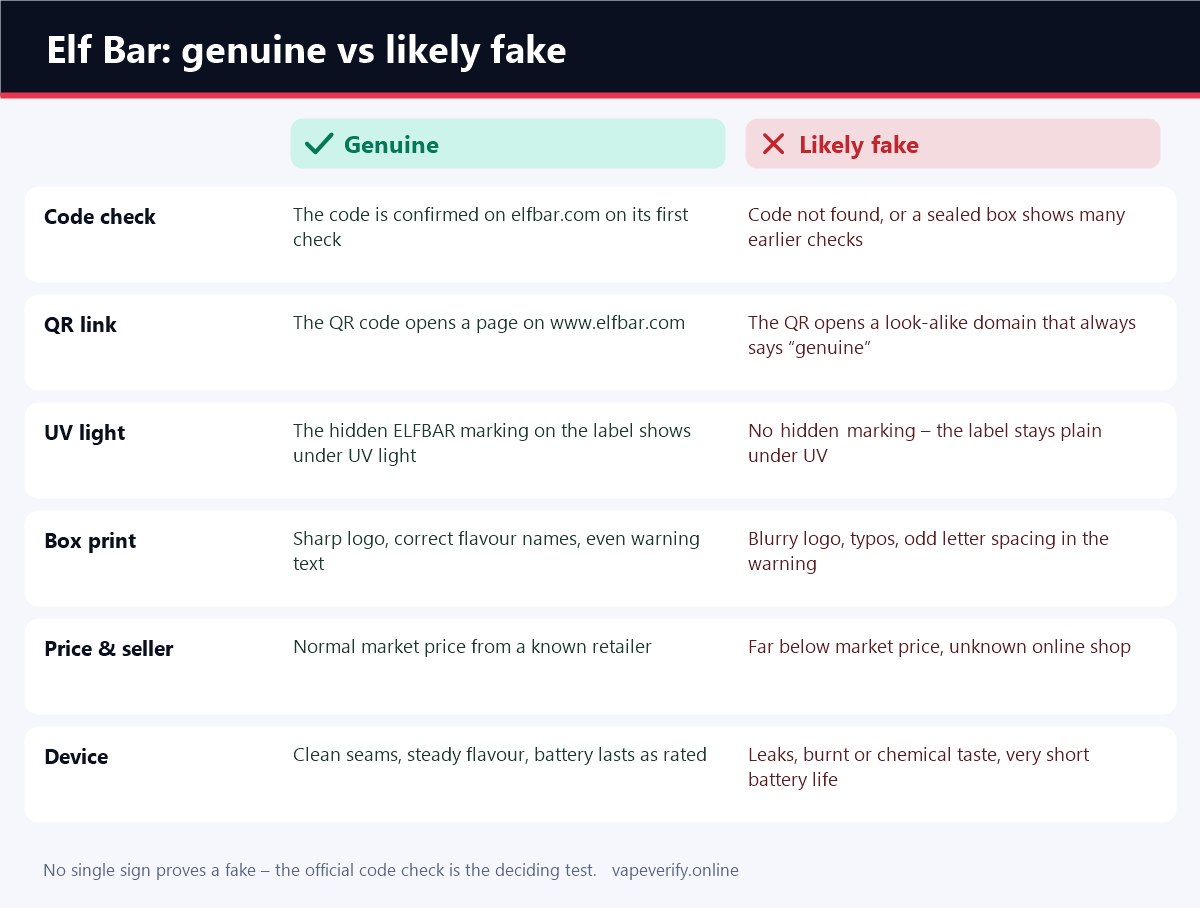
- Check the address bar: the result must be on www.elfbar.com. Fake QR stickers often lead to look-alike sites that always say “genuine”.
- If a brand-new, sealed device shows that its code was already checked many times, the code was most likely copied onto a fake box.
Step 2: Check the physical security features
Elf Bar labels also carry physical anti-counterfeiting technology that is very hard for clone factories to copy. The two official Elf Bar videos below show how it works.
- UV light test: shine a UV (blacklight) torch on the label. On a genuine label the hidden ELFBAR marking becomes visible. A label that stays completely plain is a red flag.
- Marker test: as shown in the video, shading the label with a marker and wiping it reveals the ELFBAR text on a genuine label. Do this only after you have checked the code, so the code stays readable.
Step 3: Look at the box
- Print quality: blurry logos, slightly wrong colours and fuzzy flavour names are typical of fakes.
- Spelling and spacing: look for typos in flavour names and uneven letter spacing in the nicotine warning – a detail counterfeiters often get wrong.
- Local requirements: a box sold in the EU should carry the health warnings and language required in that country. Be aware that some fakes are now localised too, so this alone is not proof.
- Compare with elfbar.com: model names, flavours and colours should match the official product pages exactly. An “Elf Bar” model or flavour that does not exist on elfbar.com is a giveaway.
Step 4: Look at the price, the seller and the device
- A price far below the normal market price, or an unknown online shop, should make you check twice.
- On the device: leaks, a burnt or chemical taste from the first puff, loose parts or a battery that dies long before the rated puff count all point to a counterfeit.
What to do if your Elf Bar is fake
- Stop using it.
- Keep the box, the receipt and a screenshot of the failed code check.
- Ask the seller for a refund.
- Report it to Elf Bar through the Report Counterfeits page on elfbar.com or by email to [email protected].
Check yours now: verify your Elf Bar code here. For a quick printable list, see our Elf Bar real vs fake checklist.